The strike card problem: building commitment infrastructure for large-scale action
There's a meaningful difference between signing a petition and stopping work. Only one requires you to risk something. That difference is the organizing gap every strike card campaign is trying to close.

There's a meaningful difference between signing a petition and stopping work. Both are acts of political will, but only one requires you to risk something — your paycheck, your job, your relationship with your employer. That difference is the organizing gap that every strike card, every pledge form, and every "economic blackout" campaign is trying to close.
The U.S. pro-democracy movement has spent the last year running repeated experiments in large-scale coordinated action. Some have worked. Many haven't — or have worked partially, at local scale, while failing to replicate nationally. The lessons from those experiments are now visible, and they point toward a clear conclusion: a true general strike doesn't get called into existence by social media momentum. It requires a specific kind of infrastructure that most of the current movement is still building.
This article is about what that infrastructure looks like, why it's harder to build than it appears, and what the movement's most successful recent experiments can teach us about how to get there.
The petition problem
General Strike US has framed its strike card as a commitment mechanism: sign a card, receive SMS and email updates, and be counted toward the 11 million — roughly 3.5% of the U.S. population — that the organization has set as its threshold for calling a strike. The theory is coherent: build a database of committed participants large enough that the action becomes self-executing when the threshold is reached.
The problem is that a signature, even one accompanied by a phone number, is not the same thing as a commitment. Petition signing is a low-friction act that happens in an emotional moment and requires no follow-through. The gap between "I signed a strike card six months ago" and "I am not going to work today" is enormous, and no amount of email follow-up fully closes it.
Kim Moody, one of the leading writers about mass strikes in the U.S., puts it plainly: "General strikes or mass strikes are seldom simply 'called' from above — and those that are tend to be called off just as easily." The strike card model is built on the premise that commitment can be aggregated nationally and then activated centrally. History suggests that's the wrong architecture.
The January 30, 2026 national strike attempt proved the point in real time. A labor stoppage was called for January 30, but it never materialized to any significant extent. Some cities saw localized strikes, including school district closures in Colorado, but the national action did not cohere. One week earlier, something very different had happened in Minnesota.
What Minnesota actually did
The mobilization of approximately 50,000 people across Minneapolis on January 23, 2026 represented the first large-scale general strike in the United States in nearly 80 years. What began as a coordinated labor response to escalating federal immigration enforcement operations transformed into a complex exercise in multi-sector labor organizing, coalition building across institutional and grassroots boundaries, and strategic use of economic disruption to challenge federal authority.
The organizing timeline was short — weeks, not months. The action was organized by a local chapter of Indivisible, a grassroots group of volunteers dedicated to civic engagement, alongside labor unions and community organizations. What made it work was not a national database of pledges. It was pre-existing relationships between organizations that already knew how to move their people.
Labor unions, community organizations, and faith leaders came together to call for a general strike and statewide demonstrations. Hundreds of small businesses, community organizations, and cultural institutions across the Twin Cities and greater Minnesota pledged to close or adjust operations in solidarity with the strike, many citing concerns over the impact of ICE operations on immigrant communities and local civil liberties.
That's the structural difference. Minnesota had what the national movement lacked: accountability structures. When a union calls on its members to walk out, a faith community asks its congregation to stay home, or a local business network commits to closing — those are commitments embedded in relationships with real social consequences for non-compliance. The person who signed a national strike card in October and then quietly went to work in January faced no such accountability. The Minneapolis worker whose union steward was watching the picket line faced a very different calculus.
An ICE official noted ahead of the action: "What we've seen that's a bit different here [from immigration raids in other cities] is the organization of some of the groups. The groups are a bit better organized. They've got some excellent communications." Excellent communications built on pre-existing organizing relationships, not a sign-up form.
The three components of commitment infrastructure
The Minnesota experience points toward what commitment infrastructure actually requires. It has three distinct components, and national-scale general strike organizing tends to underinvest in all three.
Geographic anchoring. The unit of accountability in a strike is local. Workers show up or don't show up in a specific workplace in a specific city. Businesses close or stay open on a specific block. The organizing that makes those decisions happen is relational and local — it cannot be substituted for by national communications infrastructure. This means that commitment infrastructure has to be built at the neighborhood, workplace, and district level first, with national coordination layered on top.
Sector organization. A tiny centralized group calling a general strike rarely has the capacity to echo across a country with nearly 350 million people. What creates economic disruption is participation by workers in sectors that are economically central: transportation, logistics, healthcare, education, hospitality, food service. Organizing those sectors requires working through existing labor institutions — unions, worker centers, trade associations — because those are the organizations that already have relationships with workers and mechanisms for collective decision-making. A pledge database that bypasses existing labor organizations isn't a strike infrastructure; it's a contact list.
The cascade activation problem. Even with geographic anchoring and sector organization, a truly national simultaneous action requires a reliable activation mechanism — a way to move a signal from the decision to act to hundreds of local networks within hours. This is the piece the movement has talked about least and built the least. Minnesota succeeded in part because the organizing was local enough that activation could happen through pre-existing communication channels. A national action requires something more: a tested, redundant communication cascade that organizers at every level have practiced in advance.
The subpoena problem no one wants to talk about
There's a fourth component of commitment infrastructure that is rarely discussed publicly because it's uncomfortable: data security for commitment databases.
A database of people who have pledged to participate in a strike is a legally sensitive document. General Strike US's strike card page notes that participant data will never be shared or sold. That's a privacy policy, not a legal protection. A federal grand jury subpoena seeking the names and contact information of committed strike participants is a real possibility, particularly in the current enforcement environment — and a privacy policy provides no protection against one.
This isn't a hypothetical. Labor organizers have faced subpoenas for organizing records throughout U.S. history. Digital commitment databases make those records easier to subpoena and harder to protect than the paper files of earlier eras.
The General Strike US organization has been notably thoughtful about this in their public-facing process documentation — establishing transparency about what they hold and how it's handled. But most local commitment infrastructure is being built without any consideration of subpoena risk.
The practical implication: commitment databases should be designed with data minimization principles from the start. Collect the minimum information needed to maintain the commitment relationship. Use encrypted storage. Establish and document clear data retention policies. Understand that anything you collect about who has committed to strike action could be compelled in discovery, and design your data practices accordingly. (Article 4 in this series, on digital security as organizing practice, covers these principles in more detail for organizers who want to apply them.)
What the South Korean model adds
The December 2024 South Korean response to President Yoon Suk-yeol's martial law declaration offers a useful comparison case — not because the political contexts are identical, but because the coordination architecture was distinctive.
The response was rapid and massive, with hundreds of thousands mobilizing within hours to surround the National Assembly and effectively reverse the martial law declaration. What enabled that speed was not a pledge database or a social media campaign. It was a combination of pre-existing labor infrastructure through the Korean Confederation of Trade Unions, established communication protocols among civil society organizations that had been maintained over years, and a clear, geographically specific objective (get to the National Assembly) that allowed autonomous local action to converge without requiring central coordination.
The lesson is not that the U.S. movement needs to replicate South Korean conditions — it doesn't, and the political contexts are different enough that direct comparison is limited. The lesson is that rapid large-scale mobilization depends on infrastructure built before it's needed: trained networks, established communication channels, and autonomous local capacity to act within a shared framework.
Building toward it
The gap between where U.S. general strike organizing is now and where it needs to be is large, and it won't close through any single organizational initiative. But it can close through sustained, distributed infrastructure-building at the level where commitment is actually made and honored: locally, sectorally, relationally.
May Day Strong, which organized the May 1, 2026 national day of action, explicitly positioned it as a "tactical escalation" and "economic show of force" — and organizers described it as a rehearsal for broader power-building ahead of the midterms. That framing is exactly right. Some organizers view May Day events as a dress rehearsal for something closer to a general strike in 2028 — but acknowledge that would require participation by large unions whose members may not yet feel prepared for such action or its potential political and employment consequences.
That's an honest assessment of where the movement is. The infrastructure that would make a true general strike possible in 2028 has to be built between now and then. Here's what that building actually looks like in practice:
At the local level: Build and maintain a list of organizations in your area — unions, faith communities, worker centers, business associations — that have committed to participate in coordinated action. Maintain that list actively, not just at moments of crisis. Establish and test communication protocols with each of those organizations so you know how to reach them when you have hours, not days.
At the sector level: Identify the economic sectors in your area where participation would matter most and begin building relationships with worker organizations in those sectors now. This is slow, relationship-intensive work that can't be compressed into a crisis window.
On activation: Design and practice your communication cascade before you need it. Know who calls whom, in what order, through what channels, with what backup if the primary channel fails. Run drills. The Minnesota organizers who were praised for their "excellent communications" didn't develop them in January 2026.
On data security: Build your commitment infrastructure with the assumption that it could become a legal target. Minimize what you collect, encrypt what you store, document your data practices, and consult with legal support organizations before a crisis rather than after one.
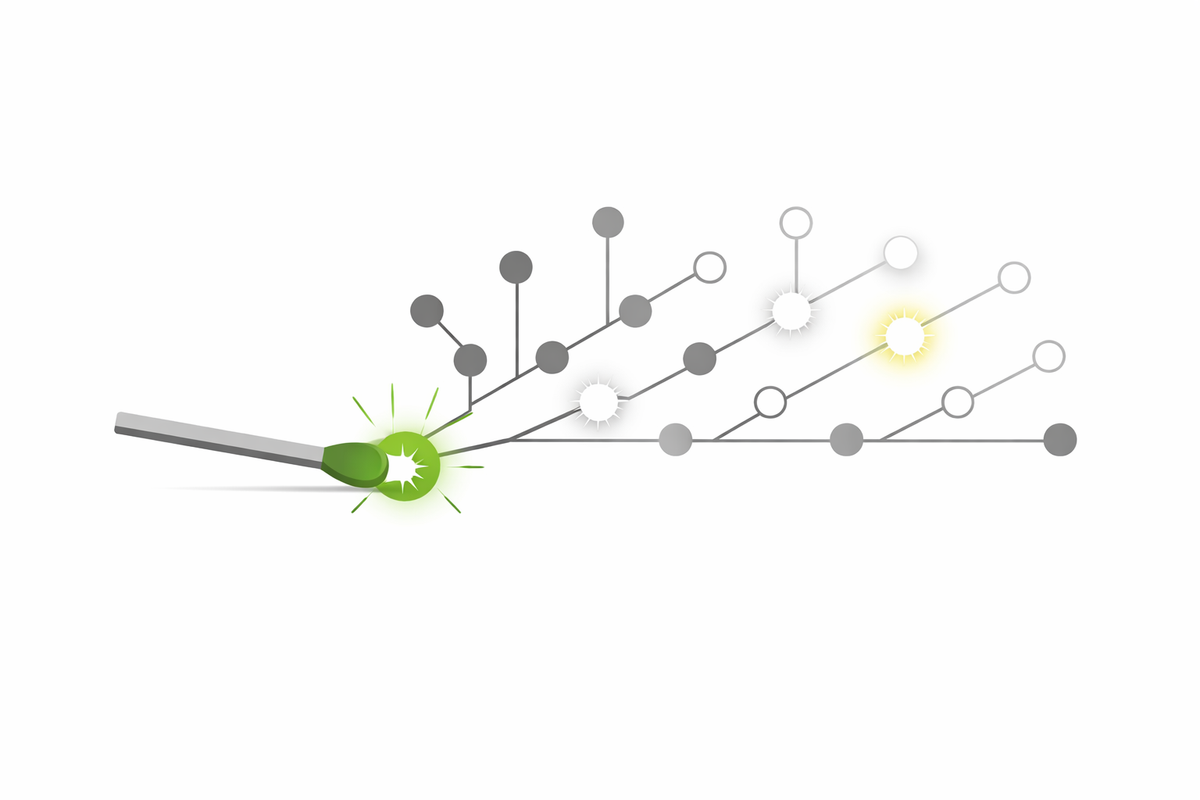
The strike card is a useful tool for building public momentum and tracking intent. It is not, by itself, commitment infrastructure. The difference between the two is relationships — and relationships are built through the slow, unglamorous work that makes action possible when a spark finally lands where there is fuel.
This article is part of Building a Movement, an eight-part series on digital infrastructure for the pro-democracy movement.