From supporter to organizer: building the commitment pipeline
Most organizing groups have supporters. Many have activists. Far fewer have developed the organizer layer that makes a movement self-sustaining. Here's how to build the pipeline — and the digital tools that support each transition.

The 3.5% threshold isn't a broadcast problem. It's a pipeline problem.
Erica Chenoweth's research on nonviolent movements is frequently cited as evidence that protest works — that if enough people show up, change follows. But the 3.5% figure describes peak active participation, not social media followers, not petition signers, not people who agree with you in a poll. It means people who are doing something: showing up, taking action, recruiting others, sustaining effort over time.
The United States currently has tens of millions of people who oppose what is happening to their democracy. It does not have anywhere near 3.5% — roughly 11.5 million people — in active, sustained participation. The June 2025 No Kings protests drew an estimated 4 to 6 million people. The October wave reached close to 7 million. Both were historic. Neither crossed the threshold.
The gap between where the movement is and where it needs to be is not primarily a messaging gap. It is a pipeline gap: the gap between the people who agree with you and the people who are with you.
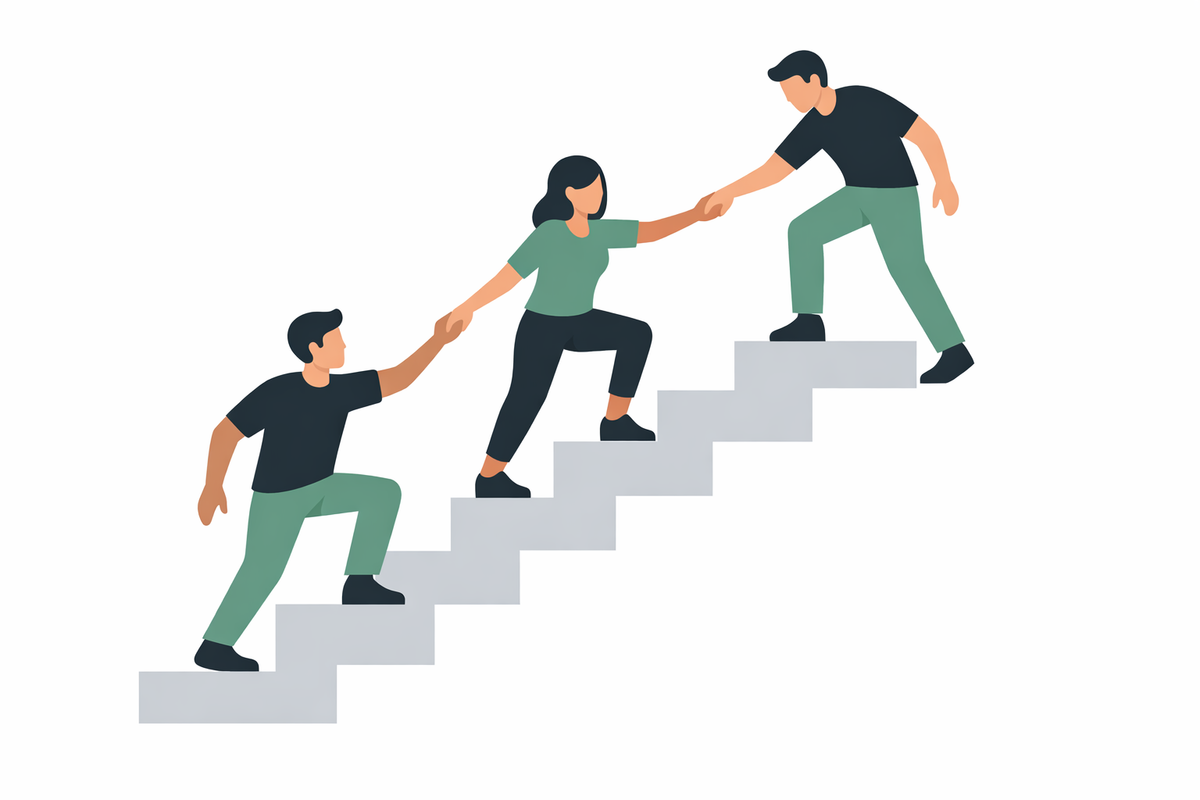
Closing that gap requires understanding that agreement does not produce action, and that action does not automatically produce organizers. There are three meaningfully different stages on the path from bystander to movement builder — and each transition requires something different from you, from your tools, and from your organization.
Three stages, three transitions
The language of "supporter" is used loosely in most organizing contexts, often to mean anyone who has expressed sympathy with the cause. That's too broad to be useful. A more precise framework distinguishes three roles:
A supporter agrees. They follow your social accounts, open your emails, maybe sign a petition. They're with you in spirit, and their numbers are large. But their relationship to the movement is passive — they receive information; they don't produce action.
An activist shows up. They attend events, respond to calls to action, write letters, phone bank, participate in rallies. They have crossed from passive agreement into active participation. This is the layer that Chenoweth is actually counting. Getting someone here is the first major transition.
An organizer takes ownership. They recruit others, lead meetings, own a piece of the infrastructure. They are not just participating in the movement — they are responsible for it. They are the ones who make the movement durable, scalable, and able to function under pressure.
Most organizing groups have supporters. Many have activists. Far fewer have developed the organizer layer that makes a movement self-sustaining. And the reason, in most cases, is that they're trying to jump directly from supporter to organizer — skipping the activist middle entirely, or asking too much too soon and losing people in the gap.
The commitment pipeline is the system by which you manage all three of these transitions deliberately: moving people from passive agreement to active participation, and from participation to leadership.
The first transition: supporter to activist
The supporter-to-activist transition is primarily a friction problem. People who agree with you don't automatically show up — not because they don't care, but because the path from "I support this" to "I am doing something" involves real costs: time, uncertainty about what to do, unfamiliarity with the organization, social awkwardness about entering a new community.
The first ask has to be small enough to be easy and specific enough to feel real. "Get involved" is not an ask. "Join us at our next meeting" is an ask, but it's a big one for someone who doesn't know anyone in the room. "Text your zip code to this number to find your nearest chapter" is a step. "Sign up here to get our weekly action alert with one concrete thing to do" is a step.
This is the logic behind the ladder of engagement: a structured pathway of escalating asks that moves people up gradually rather than demanding immediate commitment. The Obama 2012 campaign, often cited as a model, used this framework extensively — beginning with Facebook follows and email sign-ups, then moving to low-stakes actions like signing a birthday card for the President, before eventually asking for volunteer time and donations. The idea was to never ask for more than the relationship had earned.
For movement organizing, the same principle applies. Your ladder should be designed intentionally — not as a bureaucratic exercise but as a genuine theory of how you bring people in. What's the easiest thing someone can do to take their first step? What's the next thing after that? What does it look like when someone has crossed from supporter to activist, and what do you do to recognize and reinforce that crossing?
What digital tools support this transition:
Email with segmentation. The single most important tool for the supporter-to-activist transition is an email list — but not treated as a broadcast channel. Email becomes organizing infrastructure when you use it to segment: to know who opened your last three action alerts, who clicked the RSVP link, who has never engaged beyond the initial sign-up. Those are different people, and they should receive different asks. Every major email platform (Mailchimp, Action Network, EveryAction) supports basic segmentation; the question is whether you're using it.
Low-barrier action pages. Digital action tools — petition platforms, letter-to-legislators tools, simple RSVP forms — serve a specific function at this stage: they provide easy first steps that also generate data. When someone completes an action, you learn they're willing to act. That's information you need to make the next ask.
Peer-to-peer texting. Peer-to-peer texting — where volunteers send individually personalized messages rather than automated blasts — achieves response rates around 45%, compared to single-digit percentages for mass email. The major tools in the progressive organizing space include Hustle, ThruText, and CallHub, each of which lets volunteers send and respond to messages from a centralized platform without exposing their personal phone numbers.
The second transition: activist to organizer
This is the harder transition, and it's where most groups lose people who could become leaders.
The activist-to-organizer transition requires a fundamentally different kind of ask. You're not asking someone to show up — you're asking them to be responsible for a piece of the movement. That requires trust in both directions: you need to trust them with real responsibility, and they need to trust that the organization will support them when things get complicated.
The most common failure mode is what organizers sometimes call the "super-volunteer trap": a highly engaged activist is given more and more tasks without being given authority, training, or a clear role. They burn out and disengage, precisely because the organization valued their labor without investing in their development. Turning an activist into an organizer means deliberately developing them — giving them ownership of something real, connecting them to training and mentorship, and making their success visible to the organization.
Peer-to-peer recruitment is at the core of this transition. The most effective organizers are people who recruit from their own networks — who bring in friends, family, and colleagues, not strangers. When you help an activist understand their social network as an organizing asset, and give them the tools and support to do relational recruitment, you've begun the transition to organizer. They're no longer just participating; they're responsible for someone else's participation.
This is also where structured onboarding matters. The activist who shows up three times and then drifts away often does so because no one ever made explicit what the organization needed from them, what growth was available to them, or how to deepen their involvement. A structured pathway — a welcome call, a new-member orientation, a clearly described set of roles at different commitment levels — signals that the organization is serious about developing people, not just using them.
What digital tools support this transition:
Organizing CRMs. Contact relationship management software is the infrastructure that makes deliberate pipeline management possible. The difference between an organizing CRM and a generic email list is that a CRM tracks the relationship over time: when someone first joined, what actions they've taken, who their recruiter was, what role they play, whether they've been contacted recently and by whom. This is the data that lets you identify who is ready for the next ask and what that ask should be.
The major options in the progressive organizing space each have distinct strengths. Action Network is free for basic use, open to progressive causes, and widely used by smaller groups and coalitions. It handles email, petitions, and event RSVPs well, with reasonable list management. It's not a full CRM — it doesn't track contact history the way dedicated organizing tools do — but for groups early in their infrastructure development, it's a practical starting point. NationBuilder is a more complete system: it combines a CRM, website builder, email and texting tools, and fundraising in one platform, which makes it popular with campaigns and larger advocacy organizations. The trade-off is cost and complexity. Bonterra EveryAction (formerly EveryAction, now part of the Bonterra family) is the enterprise-tier option, used by large nonprofits and national organizations; it has deep integration with NGP VAN and is built for organizations with dedicated data staff. For most grassroots groups, Action Network or NationBuilder is the right starting point; EveryAction makes sense when you've grown into needing its capabilities.
| Tool | Best for | Trade-off |
|---|---|---|
| Action Network | Smaller groups and coalitions; free for basic use | Not a full CRM — limited contact history tracking |
| NationBuilder | Campaigns and larger advocacy organizations | Cost and complexity |
| Bonterra EveryAction | Large nonprofits with dedicated data staff | Enterprise pricing; most powerful when you've grown into it |
What all of these tools share — and what matters for this stage — is the ability to tag and track contacts by engagement level, assign follow-up tasks, and see who in your network has gone quiet and might need re-engagement.
Mobilize and event management tools. Mobilize (now part of the broader progressive tech ecosystem) specializes in volunteer and event management: matching volunteers to opportunities, tracking attendance, and making it easy for people to find ways to plug in. It's particularly useful for organizations with multiple chapters or distributed events, where a single coordinator can't track every point of contact. Attendance at events is one of the clearest behavioral signals you have that someone is crossing from supporter to activist — and consistent attendance is often the precursor to an organizer conversation.
Structured onboarding workflows. Most CRMs allow you to build automated email sequences triggered by a specific action — someone signing up as a volunteer, attending their first event, completing a training. These sequences don't replace human follow-up; they supplement it. A new volunteer who attends their first phone bank should receive an automated thank-you within an hour and a personal follow-up from their team leader within a day. The combination of digital systems and human contact is what makes onboarding feel like the beginning of a relationship rather than the processing of a form submission.
The third layer: organizers who develop organizers
A movement that requires staff to develop every new organizer will never scale. The multiplier effect — the thing that makes movements grow exponentially rather than linearly — comes when organizers develop other organizers.
This is the hardest thing to systematize with digital tools, because at its core it's relational. But technology can support it. CRMs that track who recruited whom create a visible network of relationships; those records help you understand where your organizational density is and where the gaps are. Peer-to-peer texting and communication tools that let organizers reach out personally to their own recruits — rather than routing everything through a central communications team — reinforce the relational model at scale.
The key digital infrastructure at this stage is whatever makes the organizer's job easier: tools that reduce the administrative overhead of managing a team so they can spend their time on relationship-building rather than logistics. Calendar and scheduling tools that handle meeting coordination, shared communication spaces (Slack, Signal groups) that keep teams connected between events, and simple tracking systems that make it easy to record conversations and follow-ups — all of these reduce friction for the organizer and make the work more sustainable.
Re-engagement matters here too. People fall away from movements — not always because they've stopped caring, but because life intervenes, or because no one reached out when they went quiet. A simple CRM practice — reviewing who hasn't engaged in 60 days and reaching out personally — recovers people who would otherwise drift out of the pipeline. The organizer who checks in on someone who's gone quiet is doing one of the most valuable things in the movement.
Building your pipeline
The supporter-to-organizer pipeline isn't a technology problem. The tools support it; they don't create it. What creates it is a deliberate organizational decision: that developing people is as important as deploying them.
That decision has some practical implications:
Map where people are. Before you can move people along a pipeline, you need to know where they are. This doesn't require sophisticated software — it requires the discipline to track engagement. Who are your activists? Who among them might be ready for a bigger ask? Who has been active but has gone quiet? These questions should be answerable by your organization at any given time.
Design your asks intentionally. Every communication your organization sends is an ask of some kind. Are your asks calibrated to where people are in the pipeline? Are you giving new contacts easy first steps, or asking for more than the relationship supports? Are you making the next step clear to people who are ready to go deeper?
Close the loop on every action. Every time someone takes an action — attends an event, completes a phone bank shift, recruits a friend — someone in your organization should notice and acknowledge it. This sounds obvious; it happens surprisingly rarely. The acknowledgment doesn't need to be elaborate. It needs to be personal and prompt.
Treat re-engagement as normal operations. People falling away from movements is not a failure — it's a normal feature of any large organization. The failure is not having a system for bringing them back. A monthly review of who has gone quiet, followed by personal outreach from someone who knows them, recovers more people than any broadcast campaign.
The No Kings protests demonstrated that millions of Americans are willing to show up when the moment is clear and the ask is simple. That's the supporter-to-activist transition happening at scale. What the movement is still building is the activist-to-organizer transition: the layer of people who are responsible for others, who develop new organizers from their own networks, who hold the infrastructure together between the visible moments of mobilization.
The 3.5% threshold is not just a number to hit on a single day. It describes a movement with enough organized depth to sustain pressure over time — enough people who are with you not just when it's easy, but when it's hard, when the cameras are gone, and when the next action needs to be built from scratch.
Building that depth is pipeline work. And it starts with knowing where everyone is and what they need next.
This article is part of Building a Movement, an eight-part series on digital infrastructure for the pro-democracy movement.